
How to track your cigarettes to smoke less (without the stress)
Logging every cigarette is the simplest way to learn how much you really smoke. What to track, how to read your numbers and how to use them to cut down at your own pace.
If someone asks how many cigarettes you smoke a day, you’ll probably give a round number: “about ten”, “half a pack”, “depends on the day”. You’re not lying. A lot of cigarettes simply get lit on autopilot: with coffee, after work, while waiting for the bus or after lunch. And what you don’t notice is very hard to change.
Tracking turns that rough guess into real data. With real data it’s much easier to decide what you want to change, set goals you can actually meet and, above all, see that you’re making progress.
In this guide we explain why logging every cigarette works, what’s worth tracking, how to read what you see and how to take the first step to cut down without the stress.
Why it’s so hard to know how much you smoke
Smoking is closely tied to specific moments of the day. When an action keeps repeating in the same context, it stops needing a conscious decision: the context triggers it almost on its own. That’s why it’s so common to light a cigarette and only notice a few minutes later.
Memory doesn’t help either. The cigarettes of an ordinary day blur together, and by evening we remember the “special” ones (the long break, the dinner with friends) but not the routine ones. The result is that almost everyone underestimates or rounds off how much they smoke.
What you gain by logging every cigarette
A second of attention
Logging a cigarette makes you notice that you’re about to smoke it. That small moment of attention breaks the autopilot and puts the decision back in your hands. It doesn’t mean you won’t smoke it, but you’ll smoke it knowing you’re doing it.
Patterns you couldn’t see
After a few days, patterns start to show up:
- Fixed moments: the first one in the morning, the one after lunch, the one at night.
- Heavier days: weekends, busy workdays, celebrations.
- Intervals: how much time passes between one cigarette and the next, and when that gap shrinks.
Those patterns are your map. They tell you where it will be easiest to start changing and where you’ll need more preparation.
Data to decide with (and to stay motivated)
When you know your average is 13 cigarettes a day, you can set a goal of 12 and check whether you meet it. And when, weeks later, your average is down to 10, you have hard proof that it’s working. Seeing progress in numbers is far more motivating than a vague feeling of “I think I smoke less”.
What’s worth tracking
The essential thing is the time of each cigarette. That alone lets you work out how many you smoke a day, your weekly average and the time between cigarettes.
If you want to dig deeper, during the first week you can also note, in a notebook or your phone’s notes app:
- Where you were or what you were doing (coffee, work, driving, going out).
- How strong the urge was, from 1 to 5.
- Whether you planned it or it just happened.
You don’t need to do this forever. One week with this level of detail is usually enough to understand your key moments.
Getting started: a three-week plan
Week 1: observe without judging yourself
For the first week, just log every cigarette. Don’t try to smoke less yet: the goal is to learn your real numbers. If you smoke more than usual one day, that’s fine. It’s information, not failure.
Consistency matters most this week. Log each cigarette as it happens, not at the end of the day: that keeps the data reliable and trains that second of attention.
Week 2: look at your numbers
With seven days of data, check:
- Your daily average. Add up all the cigarettes and divide by seven.
- Your average interval. How long do you usually go between cigarettes?
- Your fixed moments. Are there cigarettes you smoke at almost the same time every day?
- Your heavy days. What do they have in common?
Keep logging while you analyze: this week confirms what you saw in the first one.
Week 3: set a small goal
Using your real average, set a daily goal just a little lower. If you smoke 13 a day, try 12. It sounds small, but one fewer cigarette a day is 365 fewer a year. Once that feels comfortable for a few days, go down another one.
Small goals have a huge advantage: you meet them. And meeting one gives you the confidence for the next.
Ideas to hit your first goal
Once you know your patterns, a few simple strategies help you drop a cigarette without it feeling like a big deal:
- Delay the first one of the day. If you always smoke right after waking up, try waiting until after your shower or breakfast. A few more minutes each day.
- Stretch the intervals. If your average interval is an hour, aim for an hour and fifteen minutes. By the end of the day, one or two cigarettes will have dropped off.
- Cut the “easy” cigarette. Almost everyone has one they smoke out of habit more than desire. Start there.
- Change the routine that triggers it. If the cigarette is glued to your coffee, change where you have it or have it with someone else.
- Plan for the hard moments. If you know 6 p.m. is tough, have something ready for that time: a short walk, a call, a glass of water.
Common mistakes (and how to avoid them)
Not logging the bad days. That’s exactly the opposite of what helps: heavy days are the ones that teach you the most. Log them anyway.
Goals that are too ambitious. Going from 15 to 5 overnight usually ends in frustration. It’s better to go down gradually and make the change stick.
Logging only sometimes. Incomplete data gives you a false average. If you forget one, add it as soon as you remember.
Comparing yourself with others. Your starting point is your own. What matters is your trend, not anyone else’s.
Chasing the perfect week. There will be better days and worse ones. If you smoke less this month than last month, you’re on the right track.
What Cigarette Counter does for you
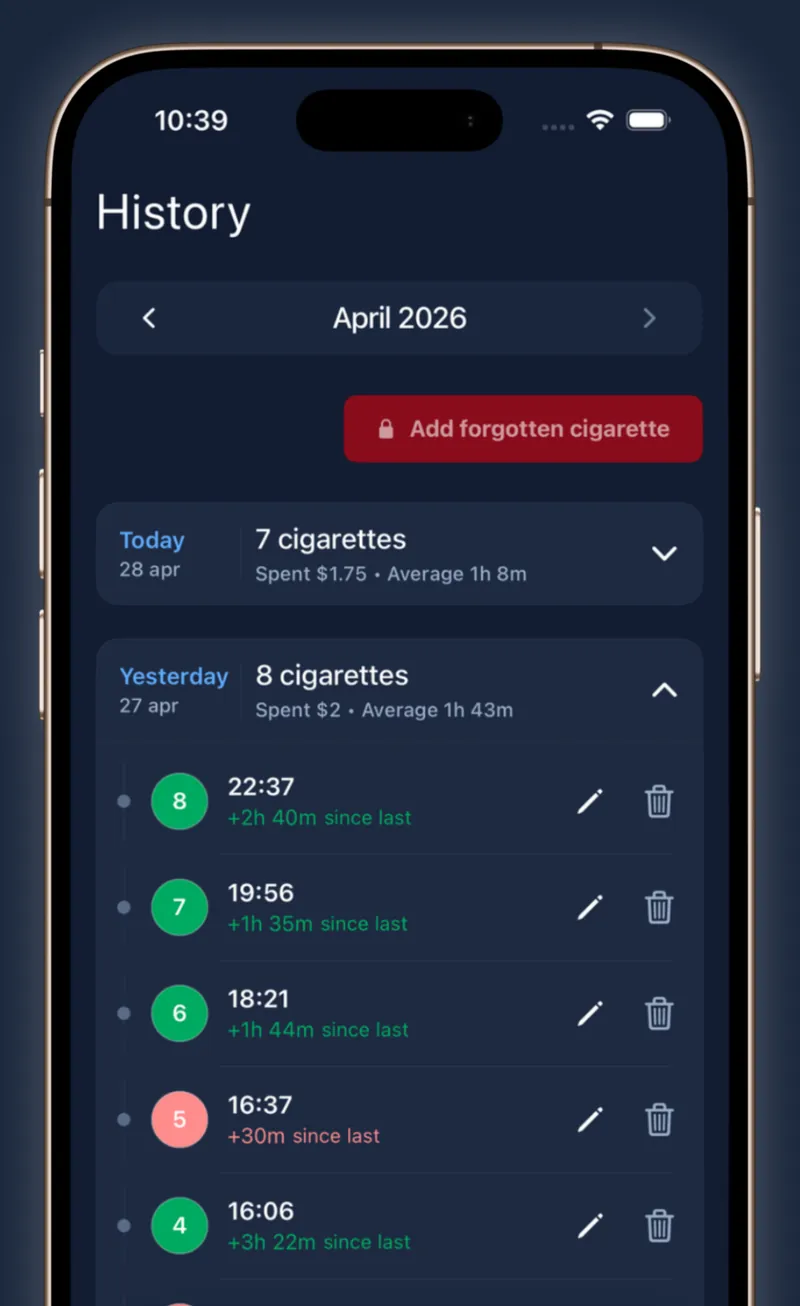
In Cigarette Counter, logging a cigarette takes one tap. The app saves the time, works out how long it’s been since the last one and shows you today’s count against your daily goal.
- Your history shows each day with its cigarettes, what you spent and your average interval.
- Smart intervals help you space your cigarettes out.
- The streak calendar and statistics show your progress at a glance.
- Your records are stored on your device.
No mental math needed: your average, intervals and progress are calculated for you.
FAQ
How long should I track before cutting down?
One week is usually enough to learn your average and your fixed moments. If your smoking varies a lot between weekdays and weekends, wait for two.
What if I forget to log one?
Add the ones you remember as soon as you can. Approximate data beats no data, and what matters is the trend over the weeks.
Is tracking useful if I don’t want to quit yet?
Yes. Knowing how much you really smoke is useful in itself, and it’s the best starting point for any decision you make later, whether that’s cutting down or quitting.
Start today
You don’t need a perfect plan to begin: just log your next cigarette. A week from now you’ll know more about your smoking than you did in the whole past year.
Want to know what it costs you too? Try the smoking cost calculator and see how much goes up in smoke every year. And to see what you’d save by smoking less, use the cut-down savings calculator.